Serving the Mouse with the Eviction Papers
This study follows on from our previous look at how mice can initially gain access to your home and the proofing measures we employ to prevent this. This article looks at how we can eradicate an infestation once mice have gained access to your household.
How do mice travel once inside a house?
When mice enter a home, they can quickly gain access to all areas of the house. This occurs because the mouse can follow existing pipework and cables that lead to wall cavities and sub-floor voids. Once in the wall cavities they can access any room where there are gaps around pipes and cables. This includes around radiators, sink pipes, bath pipes, boiler pipes, electric cables etc. Once the mice have access to the cavities, they can then travel to other floors including the loft space. The loft offers a relatively safe environment that provides ideal nesting material in the form of insulation.
What signs are typical of an infestation?
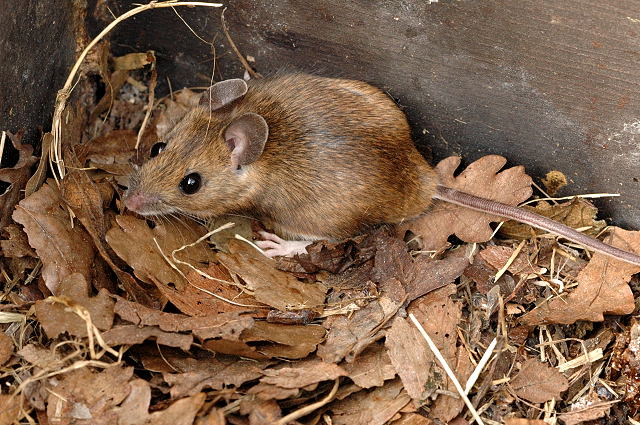
As mice are generally nocturnal, the scratching, gnawing and scurrying noises during the evening are often the first evidence that mice have taken up residence rent free. Other signs that alert the householder are the discovery of mouse droppings in various areas. The average mouse can produce up to 80 droppings a day so a large amount can be found in a relatively short period of time. Mouse droppings are 3-7 mm long, spindle shaped and can vary in colour depending on their diet but are usually dark brown to black. Mice are in the order of mammals called rodents and one feature common to this order is their constantly growing incisor teeth which they use to gnaw just about anything in their environment which can include electrical wiring. This poses the risk of power outage and even house fires.
Other signs to look out for include:
- Smear marks – These are dirty marks left where the mouse is constantly squeezing through gaps or moving around/over objects. The marks are caused by grease and dirt on the fur rubbing on to their regular routes. These are only found in longer term infestations.
- Mouse smell – The typical stale mousey smell can quickly build up as they mark their territories with urine.
- Sighting of a mouse scurrying is also quite common. Although they are mostly nocturnal, they will also sometimes venture out during the day, especially in a house that is quite a secure place with regards to predators.
Once these signs have alerted the householder to the fact that they have an uninvited guest, that’s when we are usually contacted. The earlier we are called in the quicker we can resolve the issue for the customer. Unfortunately, that one mouse doesn’t stay as one mouse for long and their breeding rate can result in numbers very quickly increasing.
How do we eradicate the mice?
When we are called out to a property and confirm that it is mice that are the culprits, we would carry out a detailed survey to determine which areas of the house the mice are using. It is here that our skills and knowledge are called upon as there are a number of usual suspects to consider:
- Kitchen – under sinks, behind kick-boards, behind fridges, behind ovens, inside cupboards
- Boiler cupboard
- Under stairs
- Utility room
- Bathroom – under bath, behind sink
- Loft
- Integral garage
This is not a comprehensive list but some of the areas that are commonly utilised by mice.
Once we have established how the mice have gained access and ascertained the areas they are using, now is the time to devise a control strategy. We can use both traps and rodenticides (poisons) to control an infestation depending on the specific situation. The rodenticides come in a variety of formulations that appeal to the mouse’s taste. The formulations include seed, whole wheat, chopped wheat, rolled oats, pasta base, paste base and pellets. The rodenticides can be presented in open trays, cardboard mouse boxes, plastic mouse boxes, and blocks secured on wires. We distribute these baits where mice are most likely to access them, giving due consideration to safety concerns.

Just some of the products we use to control a mouse infestation
Due to the inquisitive nature of mice and the short amount of time they spend at any one bait point, we ensure that there are adequate feeding points available to them. The rodenticide takes between 3-7 days to take effect, after which the mice will die. The vast majority of rodenticide treatments that we carry out result in no bodies ever being found as the mice often retreat to their nest site when they begin to feel unwell.
In some cases we use mouse traps as well as baits and in other situations we have been asked to use just traps. When devising a strategy it is often a balance between an effective treatment, any safety concerns and the wishes of the client. We have high standards where safety is concerned and as part of our initial survey we will ascertain any risks such as the presence of children and pets and use mitigating measures where applicable.
During the treatment
For the treatment to be as effective as possible it is essential that all other food sources are unavailable to the mice. Sometimes mice will eat pet food and can store generous amounts behind units and in cavity walls. Bird seed must be kept in a container with a lid so as to deter mice. Any food stuff in the kitchen should be kept in sealable containers and placed in areas away from mouse activity. If there are no competing food sources then the rodenticides will be more readily taken.
Mice can transmit a range of diseases, many of these being bacterial. With this in mind we always recommend that any food preparation areas are wiped down with an antibacterial spray before each use.
Follow up visits
The vast majority of all domestic mouse treatments that we carry out are completed within 3 visits to the property. The first visit is the initial survey and setting up of the control programme, the second visit is to rebait/check traps and re-survey and the final visit is to re-survey, remove all control measures and carry out any proofing work that may be required.
This study is to highlight the key points of a mouse control programme in a typical household. Our vast experience and expert knowledge equip us with the ability to effectively deal with any mouse infestation that you may have. We offer a highly skilled and professional service and take a great deal of pride in our ability to resolve any pest issue.
[/fusion_builder_column][/fusion_builder_row][/fusion_builder_container]